
Home List your patent My account Help Support us
Smart water saving system
[Category : - Construction Processes & Equipment- Appliances and houseware]
[Viewed 78 times]
1.1 In the field of potable water distribution, the device intelligently provides water to reduce losses in the network. It is designed to serve various entities—government agencies, companies, and residential homes—as well as installations such as bathrooms (showers, sinks, and faucets), farms, and gardens. In addition, by managing water from the different supply sources (whether in homes or public utilities), the system ensures that water loss (even when leakage or malfunctions occur) is minimized. [1][2]
Due to problems or malfunctions that lead to leakage, companies and various government agencies face significant issues—often the leakage reaches levels that cause the loss of a large quantity of potable water. In some cases, the losses can amount to approximately 22–25% of the potable water distributed through the network. This inefficiency has led to the state expending millions to cover losses in water companies. Similarly, in gardens and farms, overwatering may occur because water is not precisely monitored; sometimes more water is delivered than needed, resulting in unnecessary waste.
1.2 Summary of the Invention
The present invention relates to an intelligent water supply and irrigation system designed to reduce water loss in distribution networks. By automatically sensing the ?ow of water and any abnormal increases (or leakage) in ?ow rate, the device controls and regulates water supply.
In regions where drought and erratic climate patterns prevail, most countries face an increasing scarcity of potable water. The invention aims to ensure that every drop counts by stopping unnecessary water wastage and by providing precise irrigation to gardens and farms.
In operation, when the normal water supply usage is detected, the water ?ows from distribution networks (such as faucets, showers, etc.) are continuously monitored. Should the sensor detect an abnormal increase in the water ?ow—which indicates leakage—the device automatically cuts off power to the solenoid valve for a predetermined duration (for example, for up to one hour) to prevent further water loss. Once the leakage is stopped, the homeowner or operator may resume normal water use with just a simple key or button press.
Furthermore, the system includes a “smart irrigation” mode. In this mode, by pressing a designated button (such as option “2”), the user can select a preset irrigation time (options can include durations such as 10 minutes, 5 minutes, half an hour, one hour, up to several hours). After the irrigation period ends, the system automatically stops the water ?ow to prevent any excess or unnecessary loss.
2. what problem it solves?
2.1 Technical Problem and Prior Situation
• Problem Identification:
Under normal conditions, the water supply system suffers from fluctuating ?ow rates. During periods when water is not actively used (e.g., when faucets, showers, or taps are left open accidentally), there is a disparity between the intended usage and the actual ?ow, resulting in significant water losses.
• Prior Art Limitations:
In traditional systems, the leakage problem is not adequately addressed, leading to severe losses not only in domestic potable water but also in water used for irrigation. The magnitude of such losses has forced state agencies to spend enormous sums to compensate for the water lost in distribution networks.
2.2 Technical Solution
The invention provides a solution based on the following key elements:
1. Flow Meter Device:
o The water ?ow sensor measures the rate at which water moves within the network. It produces an electrical pulse that increases in frequency as
the water ?ow rate increases.
o Connection:
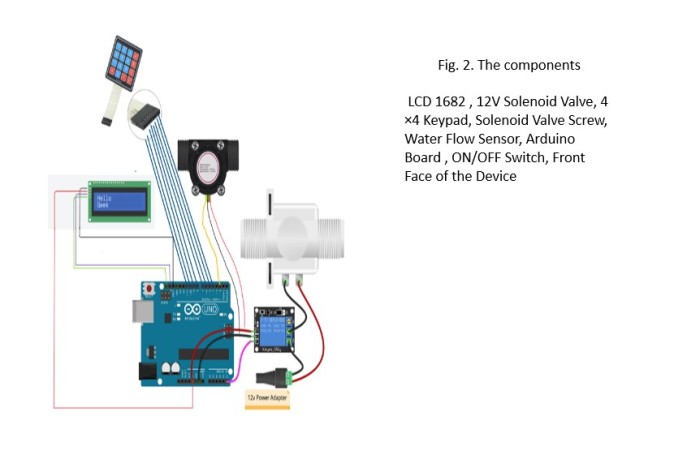
The sensor’s VCC is connected to a 5V power supply, its GND to the ground, and its signal pin to a digital input (e.g., pin 2) of an Arduino microcontroller.
o Code Snippet:
(A sample code fragment would be provided to count pulses corresponding to the water ?ow rate.)
2. Solenoid Valve Device:
o This device controls the ?ow of water by either opening or closing the valve based on instructions from the microcontroller.
o Operation:
When leakage is detected (a significant change in the pulse rate), the Arduino automatically sends a command via a relay to close the solenoid valve, stopping water ?ow. The valve is powered through a 12V power adapter (12 volt, 2A).
o Connection:
The valve is connected to a relay module that is controlled by a digital output from the Arduino.
o Code Snippet:
(A sample code fragment would be included to illustrate the digital control of the valve.)
3. User Interface:
o LCD I2C Display:
The device incorporates an LCD screen (connected using I2C with SDA to A4 and SCL to A5) to display system status and selected commands.
o Keypad:
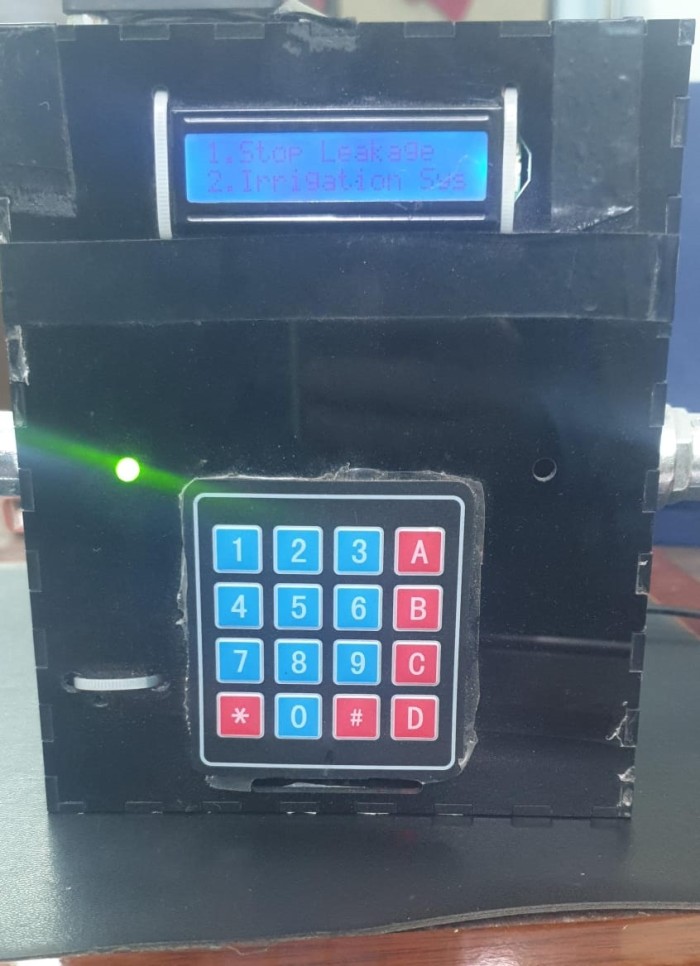
A 4×4 keypad allows the user to choose between various modes, such as “stop leakage” (for normal usage when leakage is suspected) and “smart irrigation” (for pre-set irrigation times).
o Operation Example:
Stop Leakage Mode: When an abnormal increase in water ?ow is detected, the system automatically closes the valve. The user can re-open it by pressing a corresponding key once the situation is resolved.
Smart Irrigation Mode: The user selects an irrigation duration (for example, 10 minutes, 5 minutes, half an hour, one hour, etc.), and the system will run the water ?ow for that period before automatically stopping to avoid further wastage.
4. Additional Components:
o Arduino Board:
This microcontroller serves as the central processing unit, interfacing with the sensors, relay, keypad, and display.
o 12V Power Adapter:
Supplies the necessary power for the electronic components and the solenoid valve.
o Relay Module:
Acts as a switch that the Arduino controls, thus managing the power ?ow to the solenoid valve.
5. Overall Operation:
The system monitors water ?ow in real time. Based on pre-set thresholds, it distinguishes between normal usage and leakage conditions. In leakage conditions, it cuts off water ?ow promptly; in irrigation mode, it provides the user the ability to water a designated area for a precise duration after which it
automatically stops the water supply.
2.3 Features and Advantages of the Invention
• Water Conservation:
Reduces water loss from potable distribution systems—potentially saving millions of cubic meters of water.
• Cost Efficiency:
Helps reduce the ?nancial burden on governmental agencies, companies, and homeowners by cutting down on water wastage.
• Smart Irrigation:
Provides precise control for irrigating gardens and farms, ensuring that only the needed amount of water is used.
• Ease of Use:
The user-friendly interface (LCD and keypad) allows for simple switching between normal water supply and smart irrigation modes.
2.4 Detailed Operational Modes
2.4.1. Leakage Stop Mode
Under normal usage, water ?ows with minor variations (from slow to fast) which the device continuously monitors. When a signi?cant change in ?ow rate is detected (e.g., a surge in the number of pulses from the ?ow sensor corresponding to a high rate of water usage), the system interprets this as leakage. In response:
• The microcontroller cuts the power to the solenoid valve for a set duration
(programmed within the Arduino, such as up to one hour) to stop the water ?ow.
• Once the abnormal condition ceases, the user may press a designated key to reactivate normal water supply.
2.4.2. Smart Irrigation Mode
When the user selects the irrigation mode (e.g., by pressing option “2” on the keypad), the system:
• Allows the user to set a predetermined irrigation period (options include durations such as 5 minutes, 10 minutes, 30 minutes, 1 hour, up to three hours or more).
• Initiates water ?ow to the garden or farm for the selected duration.
• Automatically cuts off the water ?ow after the set time elapses, thereby preventing overwatering and additional leakage.
In both modes, the continuous monitoring of water ?ow ensures that no unnecessary water is wasted once irrigation is completed or if leakage is detected, with the system
reverting to standby until further user intervention.
• Automatic Operation:
The system automatically stops water ?ow in case of abnormal leakage rates, thereby protecting water resources without the need for constant manual
monitoring.
3. what is the benefit comparing the existing technologies?
The invention is applicable in several fields, including:
• Governmental Institutions & Agencies:
To control and reduce water wastage in public utilities.
• Companies & Factories:
Where water conservation is vital to reduce operational costs.
• Residential Homes:
Ensuring that households only use the water they need.
The conclusion
The invention represents a signi?cant advance in water management technology. By integrating a water ?ow sensor, solenoid valve control, and an intuitive user interface through an Arduino-based system, it reduces potable water loss and provides efficient, smart irrigation. The resulting bene?ts include substantial water conservation, cost savings, and improved resource management for public utilities, industrial sectors, and individual households.
Finally: FUTURE ENHANCEMENTS
Future enhancements could include:
1. Wireless communication for remote monitoring and control.
2. Integration with smart home systems.
3. Enhanced user interface with more detailed settings and feedback
 Patent publications:
 No published information
Ask the inventor for a copy of the filed application
Asking price:
Make an offer
Make an offer
 Great invention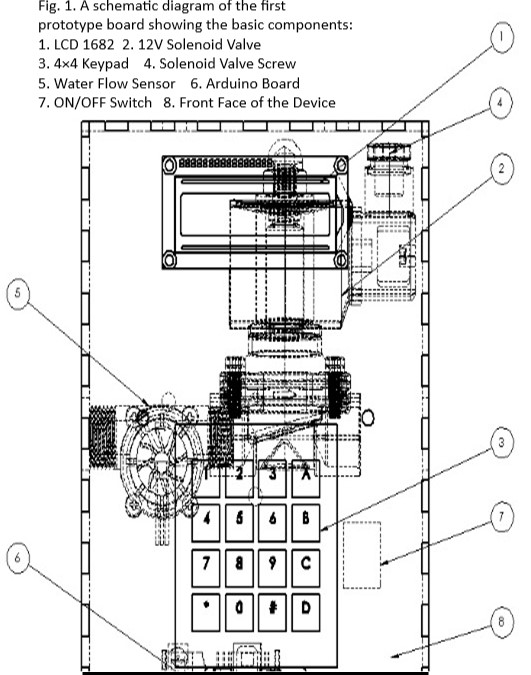
[ Home | List a patent | Manage your account | F.A.Q.|Terms of use | Contact us]
Copyright PatentAuction.com 2004-2017
Page created at 2025-12-14 2:44:38, Patent Auction Time.